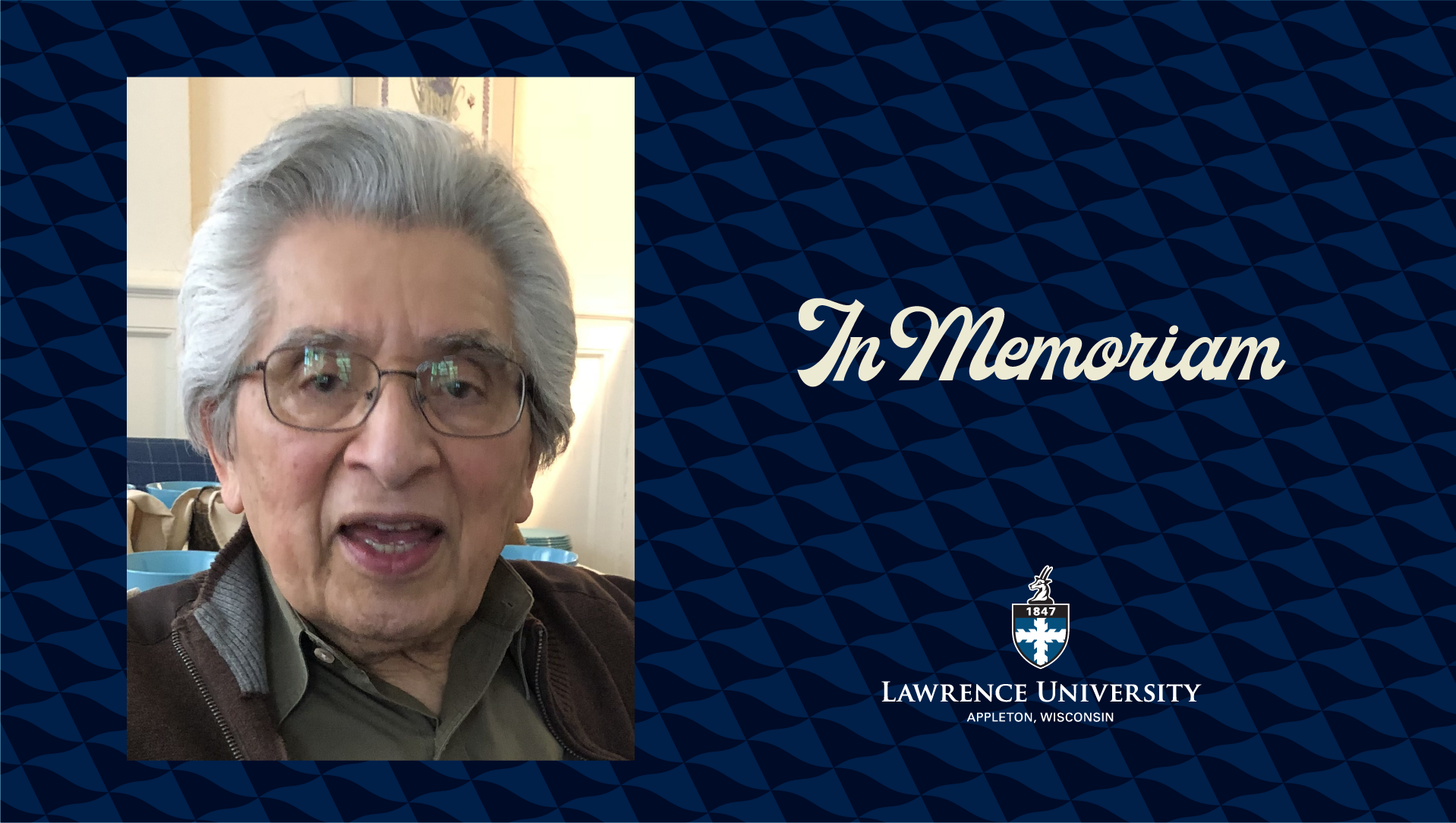
Professor Emeritus Hugo Martinez-Serros passed away on Feb. 26, 2026, leaving behind family, friends, and generations of students whose lives he had touched. He was 95.
Hugo taught at Knox College and the University of Oklahoma before joining the faculty of Lawrence University in 1966. He taught Latin American and Spanish Literature for the next 29 years until his retirement in 1995.
A first generation Mexican-American raised in South Chicago, Hugo earned his bachelor of arts degree in Spanish from the University of Chicago, and his master’s and Ph.D. degrees from Northwestern University.
In addition to teaching, Hugo was passionate about writing. During his tenure at Lawrence, he published “The Last Laugh and Other Stories,” a collection of short stories about life in the Mexican-American community of South Chicago, a selection from which was published in Chicago magazine. In retirement, Hugo continued to write, publishing two novels, “Enamored Dust,” and “The Brothers Duran of Mexican South Chicago.” He published a new edition of his short stories titled “Steeling Chicago: South Side Stories.”
Throughout his life, Hugo was committed to education and social justice. He adored teaching and though he expected much of his students, he was always encouraging and supportive of them. One of his former students, Barbara Lawton ’87, a current member of the Lawrence Board of Trustees and former Wisconsin Lt. Governor (2003-11), described the impact Hugo made on her academic journey.
“I was convinced that if Hugo would take the time to publish his brilliant method of teaching the complexities and nuances of the Spanish language, it would become the gold standard,” she said. “But he was leading students to see how language revealed culture, and then to learn how to read and write anew in the study of Latin American literature. And then the conversation continued at regular tertulias (salons) hosted in his home, building a vibrant community of Spanish speakers. I came to Lawrence to test my intellectual mettle, and Hugo pushed me, and all his students, to discover themselves as scholars. The quintessential Lawrence difference. He gave us his all.”
Another former student, Peter Kelly ’87, echoed Lawton’s sentiments about finding challenge and inspiration in equal measures in Hugo’s classes.
“Hugo was obsessive in his drive to have students not simply read and follow plot, but also to live within the words on the page,” Peter said. “He never let general observations on characters or narrative go unchallenged, always exhorting the student to justify based on text. He would bring his whole body to bear, patiently quieting his voice while deepening his gaze as he strained to place the student back into the pages of the story or novel while guiding the reader to find the author’s precise word choice or phrasing that substantiated the general observation. It could be a tiring and painful exercise, but it was clear that Hugo gave energy in equal measure to the student. He was indefatigable in the classroom, usually patient, always demanding, and relentlessly supportive.”
Frances Siekman Romero ’73 was part of a study group travelling with Hugo to Guanajuato, Mexico, for an experience that would end up changing the course of her life.
“Professor Martinez encouraged me to be open, to adapt, and to fully embrace a new culture—even when it meant stepping far outside my comfort zone and learning to accept whatever was placed before me,” Frances said. “Little did I know, I would embrace the culture a little too well—and never leave. It was in Guanajuato where I met my husband, the father of my children, and where the foundation of my family began. That journey has brought us 10 children and 10 grandchildren, and in 2000, I became First Lady of Guanajuato when my husband, Juan Carlos Romero, became governor. Professor Hugo Martinez did more than teach—he opened doors, broadened perspectives, and created opportunities that continue to ripple across generations. His legacy lives on in my life and my family because of the experiences that began with him. I am forever in his debt.”
Luis Alberto Villaseñor G. ’79 met Hugo in Guanajuato, Mexico, where the professor served as director of Lawrence University’s off-campus program for Spanish students. He learned about Lawrence from students in the program and dreamed of one day attending himself. Thanks to what he described as a combination of providence and generosity, Luis was able to enroll at Lawrence, where he earned his B.A. in Mathematics.
“Despite my focus on mathematics, I had always intended to take a class with Professor Martínez—or as my mother affectionately called him when she first met him in Guanajuato, Señor Mister Martínez,” Luis said. “His course on the great Spanish writer Miguel de Cervantes was among the finest I took in my entire academic career. Professor Martínez was an exceptional lecturer—passionate, deeply knowledgeable in Spanish literature, and uniquely gifted at guiding students to fully appreciate what is often considered the greatest novel ever written, Don Quixote. His lectures transported us to the age of knights and chivalry, making us feel as though we ourselves were setting out to battle windmills or falling in love with the imagined beauty of Dulcinea. In the classroom, he would vividly bring to life the sardonic humor and earthy wisdom of Sancho Panza, while also conveying the timeless reflections of Don Quixote as he instructed his loyal squire in the deeper meanings of life. While deeply saddened by the passing of Professor Martinez, we are profoundly grateful for the privilege of having known him.”
For Juan Hernandez, a visit by Hugo to his parent’s Instituto Guanajuato for Arts and Languages would shape the course of Juan’s life.
“A gifted teacher and writer, Dr. Martinez inspired in me a deep appreciation for language and literature,” Juan said. “During that visit, he spoke about an assistantship scholarship for students from the University of Guanajuato to work with the Spanish faculty and their students. I immediately applied, and within a few months, at only age 17, I was on my way to Lawrence. The Martha Siekman family in Appleton welcomed me as one of their own, supporting not only me but many students over the years, as generous donors to Lawrence. Guided by extraordinary mentors, I completed my B.A. at age 19, becoming one of the youngest graduates in the University’s history. I was not an “A” student, but I was a student who understood the value of those mentors, especially Professor Martínez. Years later, I earned my Ph.D. in Spanish and English Letters – a path that began with his encouragement. I will never forget the support I received from Dr. Martínez.”
Outside the classroom, Hugo worked for social justice in all its forms. He was most proud of his family’s role as resident family for the Appleton chapter of the ABC (A Better Chance) program for two academic years in 1970-71 and 1971-72. In this role, he and his wife, Mary-Alice, provided guardian care, moral support, a positive learning environment, and home-cooked meals for 10 young men who attended Appleton area high schools. A highlight of his time at Lawrence was the great honor of hosting acclaimed poet, memoirist, and civil rights activist Maya Angelou at his home when she came to Appleton in 1976 to receive an honorary degree from Lawrence.
In retirement, Hugo moved to Colorado and then New Mexico before settling in Madison, Wisconsin to be near his children. Fiercely independent to the end, he was an accomplished cook who enjoyed reading, classical music, fine food, good wine, and most of all, the company of those he loved.
Though he is deeply missed, his spirit lives on through his stories, and through the memories of all those who cherish him. He is survived by his loving children, grandchildren, and great-grandchildren.
The family requests that gifts in Hugo’s memory be made to the Lawrence Fund. https://inside.lawrence.edu/giving-lawrence/how-give