Passionate. Irrepressible. Joyful.
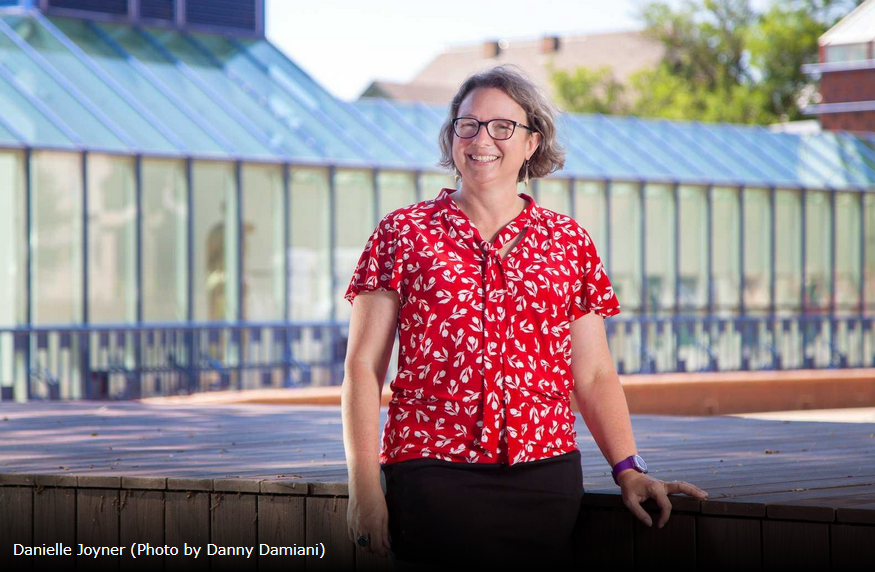
Her colleagues mentioned these traits again and again when they spoke of Associate Professor of Art History Danielle Joyner, whose death on March 20, 2026, left the campus community devastated by her loss. Danielle died of cardiac arrest while leading a group of Lawrence University students on a spring break trip to New York City, where she was bubbling over with her typical enthusiasm for the opportunity to share her love of the medieval world with her students. She was 52.
“We are heartbroken by the sudden loss of Danielle Joyner, whose dedication to teaching, learning, and personal connection defined her time at Lawrence,” said President Laurie A. Carter. “An inspiring scholar, teacher, and mentor, Danielle brought deep intellectual curiosity, compassion, and joy into every space she entered. Her passion for art history and her care for students shaped lives far beyond the classroom. She connected with people with a warmth and generosity that made our community stronger. While her time with us was cut tragically short, the mark she made on Lawrence will endure in the minds she challenged, the hearts she touched, and the vibrant spirit of inquiry she embodied.”
Danielle joined the Lawrence University faculty in 2018 and quickly became a vital member of the campus community, as both a beloved professor and cherished colleague. She delighted in sharing the art, architecture, and culture of the Middle Ages in her classes. Her hands-on approach to teaching helped to vividly bring art history to life for her students.
Nathan Wall ’25 met Danielle for the first time as a classmate rather than as a professor. She was participating in a colleague’s class and he just assumed she was a guest or non-traditional student. Even so, she made an impression, and when it was time to take a fine arts class to fulfill a graduation requirement, he chose Danielle’s Greek and Roman Art class – despite the 8:30 a.m. start time. It quickly became one of his favorites.
“Every single day, Danielle was kind, encouraging, thoughtful, and lively,” Nathan said. “She was a good reason to get up and be ready for class. Her positivity could make your day better. She understood that many students in an intro class may not be particularly interested in the material. Instead of taking it personally, she did what she loved because she loved it, and she tried to make the class fun for every student. Danielle could have made ‘Watching Grass Grow’ a fun class.”
“An incredibly accomplished teacher and scholar, Danielle was a fierce advocate for her students, her colleagues, and everything related to medieval studies,” said Provost Peter Blitstein. “She was very kind and sought out meaningful connections with people all across our campus. Losing Danielle is heartbreaking for our community.”
Intelligent. Enthusiastic. Collaborative.
The study of the Middle Ages, by its nature, crosses many different disciplines, ranging from history, art, archaeology, literature, religion, music, biology, anthropology, and more. Danielle frequently partnered with faculty from other departments to co-teach classes that explored the medieval world from diverse points of entry.
She collaborated with Associate Professor of Music Sara Gross Ceballos and Associate Professor of Spanish Madera Allan on on an interdisciplinary course exploring the intersections of art, music, and literature found in the hundreds of 13th century songs and miniatures that are part of the Cantigas de Santa Maria. That led them to co-teaching a course that featured a trip to Toledo, Spain, where the topics explored in that earlier course came to life with an exploration of the places and cultural dynamics that define that stretch of European history. She described the hands-on approach in a 2022 article for the LU news blog.
“To get at any aspect of an object made 1,200 years ago, you have to do history, you have to do literature. If it’s a church object, which many of them are, you need to understand the liturgy. I think all of art history is very interdisciplinary, but medievalism especially opens itself up to those different approaches” Danielle said. “Most people don’t go around thinking about the Middle Ages or medieval art or art history. And, so, the interdisciplinary approach I feel gives students ways of finding connections between the long ago and the now, connections that they maybe never would have thought about.”
A class she co-taught with Martyn Smith, Associate Professor of Religious Studies, examined the differences between the travels and lessons of two famous explorers, Marco Polo, a Venetian traveler of the 13th century, and Ibn Battuta, a Muslim traveler of the 14th century.
“It ranks among my favorite classes ever because we would transfer the reins to lead discussions and students were exposed to discussions between faculty,” he said. “I don’t think there could be a better way of introducing students to the medieval world than a class like that.”
Danielle had similar collaborations planned in the months ahead. She was scheduled to co-teach a summer immersion course for high school juniors and seniors with Associate Professor of Physics Megan Pickett and Associate Professor of English Celia Barnes, exploring the universe through the lens of cosmology. She also had a Fall Term collaboration planned with Martyn Smith and Massimiliano Veritá, instructor of Arabic, Italian, and Religious Studies, that would take students on an exploration of Dante’s Inferno.
Caring. Generous. Effervescent.
“We strongly felt that we needed to be evangelists for the old stuff,” Martyn said. “She believed it was important that ancient materials continue to be taught and studied. She was passionate about that.”
Soon after coming to Lawrence, Danielle formed a group called LASER, an acronym for Long Ago, Still Extremely Relevant, that engaged faculty from numerous disciplines who taught about ‘old stuff.’
“She felt we should band together and support each other and co-teach in as many ways as we could.” Martyn said. “She will be so greatly missed at Lawrence University, and one reason was the way she could connect with people and bring them together.”
Danielle was instrumental in creating the Appleton Lyceum, a monthly series of well-attended talks by Lawrence faculty hosted at the Appleton library and aimed at engaging the local community.
“It was an ongoing project we worked on to get the Humanities living outside of the university, and helping people see that the past is relevant to the present and future,” Martyn said. “This was our vision for it.” He added, “We spoke about the project the week before she left for her spring break trip. She was just energized and full of plans for what came next. She was so enthusiastic about showing and interpreting the medieval world for people. That was her life’s work.”
Kind. Encouraging. Hopeful.
Associate Professor of History Brigid Vance also collaborated with Danielle on the Appleton Lyceum project.
“She was a brilliant community organizer, within the campus community and the broader Appleton/Fox Cities community,” Brigid said. “Danielle held herself to really high standards and did it with such enthusiasm and joyfulness that it was infectious. She was curious and spontaneous and had this brilliant long-term vision for community engagement. Her work was really starting to bear fruit.”
Brigid admired Danielle’s generous spirit and her whole-hearted way of celebrating the success of others. One example she recalled was when Danielle organized a trumpet fanfare at the monthly faculty meeting for professors who were being tenured.
“That is something she was so good at – really celebrating people, recognizing their value and letting them know their work was valued. She had an incredible intellect, but she also knew how to have fun.” She added, “Danielle’s life was a place of hope and doing. Some people will self-censure. She really had faith in the process of people doing the work together.”
Assistant Professor of Ceramics and Expanded Media Meghan C. Sullivan described Danielle as “passionate about the liberal arts, medieval history, and about art history.”
Danielle’s education reflects her enthusiasm for learning and teaching. She earned a Ph.D. and master’s in History of Art and Architecture from Harvard, and a master’s in Medieval Studies from the University of Toronto, where she also earned her bachelor’s degree. She amassed dozens of research awards and fellowships over the years to further her scholarship and was a frequent presenter at professional conferences. She published numerous articles and essays, and her book, Painting the Hortus Deliciarum: Medieval Women, Wisdom, and Time was published in 2016; she was working on multiple research projects at the time of her death.
“She was a brilliant and prolific scholar interested in writing on a broad spectrum of topics and mediums across the Middle Ages,” said Elizabeth Carlson, associate professor of Art History. “She was always thinking and planning and we marveled at all of her ideas that came bubbling out of her. She was tender-hearted and brave, willing to fight for her principles. She died doing the things she loved most – she was so happy to introduce students to New York City and the art that she loved so much.”
Beloved. Cherished. Irreplaceable.
“Danielle was a great friend and colleague,” Meghan said. “She loved the Lawrence culture of sharing knowledge, co-teaching classes, and making connections across fields. She was enthusiastic about her students and was a respected scholar in her field.” She added, “Danielle was a person who supported and celebrated others unabashedly. Our loss is tremendous.”
A memorial gathering to bring the campus community together in celebration of Danielle’s life is planned for Saturday, April 25, at 1 p.m., in the Warch Center Somerset Room.