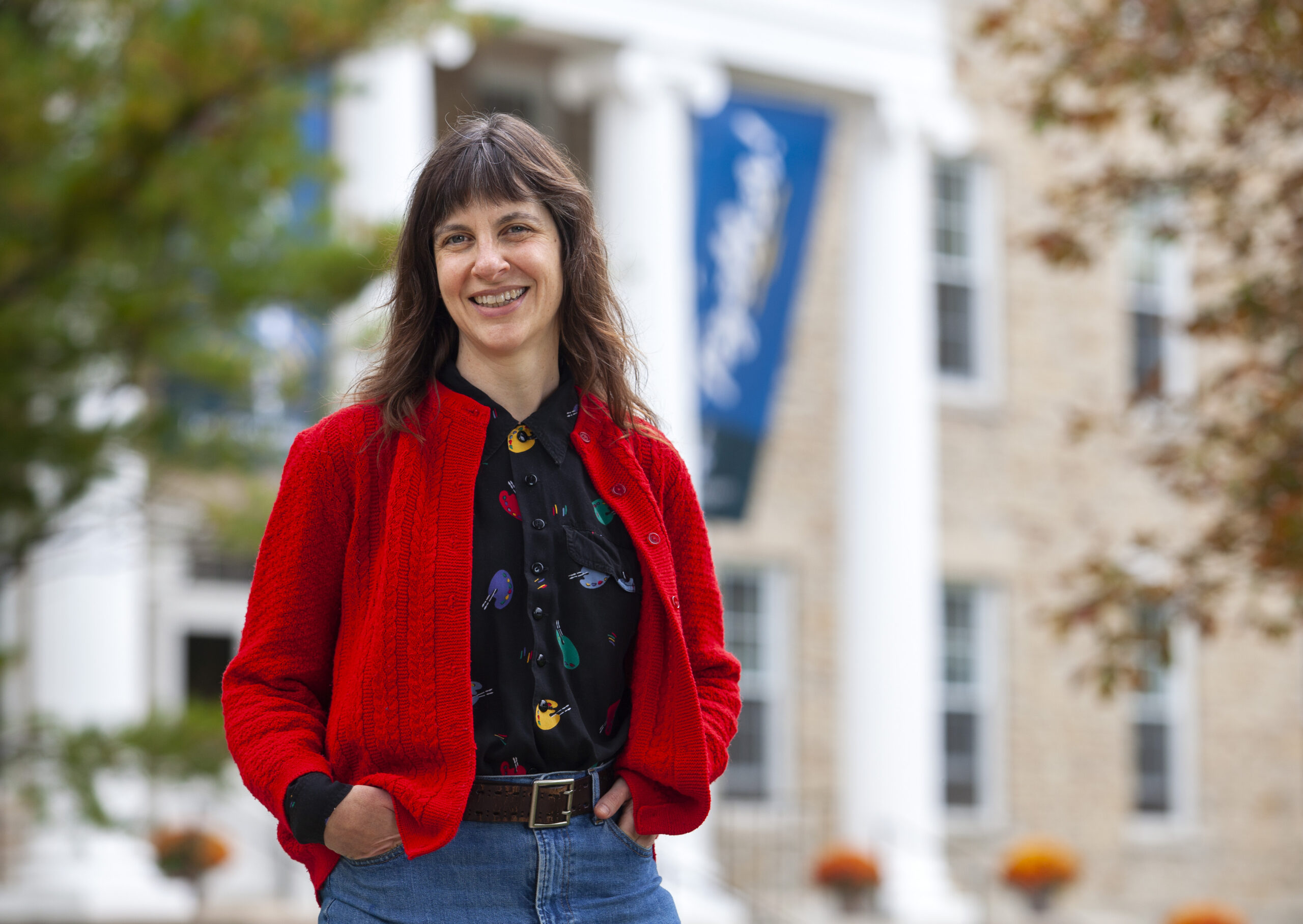
Associate Professor of English Melissa H. Range was awarded the 2025 Vanderbilt University Literary Prize for her upcoming collection Printer’s Fist.
In Range’s third book of poetry, the creative writing and 19th-century literature professor explores the 18th- and 19th-century abolitionist movement through its rich print culture.
Through a fellowship from the American Antiquarian Society, Range engaged with the era’s archival material, such as newspapers, broadsides, and letters.
“When I’m interested in something, I want to write creatively about it—not critically,” Range said.
Slated for a March 2026 publication from Vanderbilt University Press, Range’s collection will also offer her a residency at the Nashville-based university. Over a decade in the making, it is her first book since the National Poetry Series Winner Scriptorium (Beacon Press, 2016).
“It took a really long time because I needed to do the research to get it right,” she said.
Printer’s Fist is a testament not only to activism but also to Range’s journey to Lawrence University.
A path through poetry and history
Range has always wanted to tell stories. She grew up in the mountains of upper East Tennessee in a community of conservative values and low academic expectations. But she always had dreams of writing: If the authors she read in the classroom could do it, she reasoned, why not her?
A first-generation student from a workingclass background, Range attended the University of Tennessee. Both her upbringing and college experience gave her an outsider ethos, Range said.
“I’m always thinking, feeling, and recognizing the outsider,” she said. “Because that’s how I felt in academic circles.”
Originally interested in fiction, Range enrolled in a poetry workshop because the fiction one was full. Under the instruction of poet Marilyn Kallet, however, she realized she wanted to write poetry.
Kallet also offered Range a piece of advice she still uses in her classroom today.
“You have to let yourself write shit, because if you don’t, you won’t ever write any good,” Range said.
After graduating, Range worked many jobs— with AmeriCorps, with libraries, and even with a record store—before returning to academia. She even pursued a theology degree, which, she said, was for fun.
Enrolling in the M.F.A. program at Old Dominion University, Range said her mentor, scholar Alex Socarides, encouraged her interest in dense religious imagery and archival research. It was here she read activist poets Frances Ellen Watkins Harper and John Greenleaf Whittier, whose work featured in abolitionist newspapers.
“They did all this work that changed the country for the better,” Range said, “but we don’t know about them.”
Inspired by the poetry collection Native Guard by Natasha Trethewey, Range wrote Printer’s Fist as a monument to the abolitionist movement and the history of American activism. She hopes the collection will empower readers in their own communities to spearhead change.
“A lot of problems in this country arise from not looking at our history,” Range said. “If we can look at it, we can move forward.”
Excerpts from Printer’s Fist can be found in Ecotone, Poets.org, and The Nation, among other publications.
In the classroom
Range teaches courses in 19th-century literature, creative writing, and contemporary poetry. She came to Lawrence because its interdisciplinary departments allow her to teach between analytical and creative fields.
“I don’t want to teach work from one point of view,” she said. “My desire is to teach a diversity of authors, in every sense of that word.”
Range’s favorite course to teach is her advanced seminar on elusive poet Emily Dickinson. By diving deep into one poet’s work, students sharpen their research and close-reading skills—skills that are beneficial regardless of discipline, she said.
Another favorite of Range is Introduction to Creative Writing, where she balances the study of craft and activities that push writing to its limits.
One example is her bonnet activity. Range prints out various writing constraints, such as zany phrases or odd poetic forms, on slips of paper. She then places them in several bonnets for students to draw and include in a piece of writing. The change in their written voices and confidence is rapid.
As for her colleagues, Range spoke to how much passion Lawrence’s Department of English instills in students. The care for teaching among faculty is unlike anywhere else, Range said.
“Poetry and the humanities teach people how to be more curious, more empathetic, and more attuned to wonder,” Range said. “It teaches them how to be better people.”