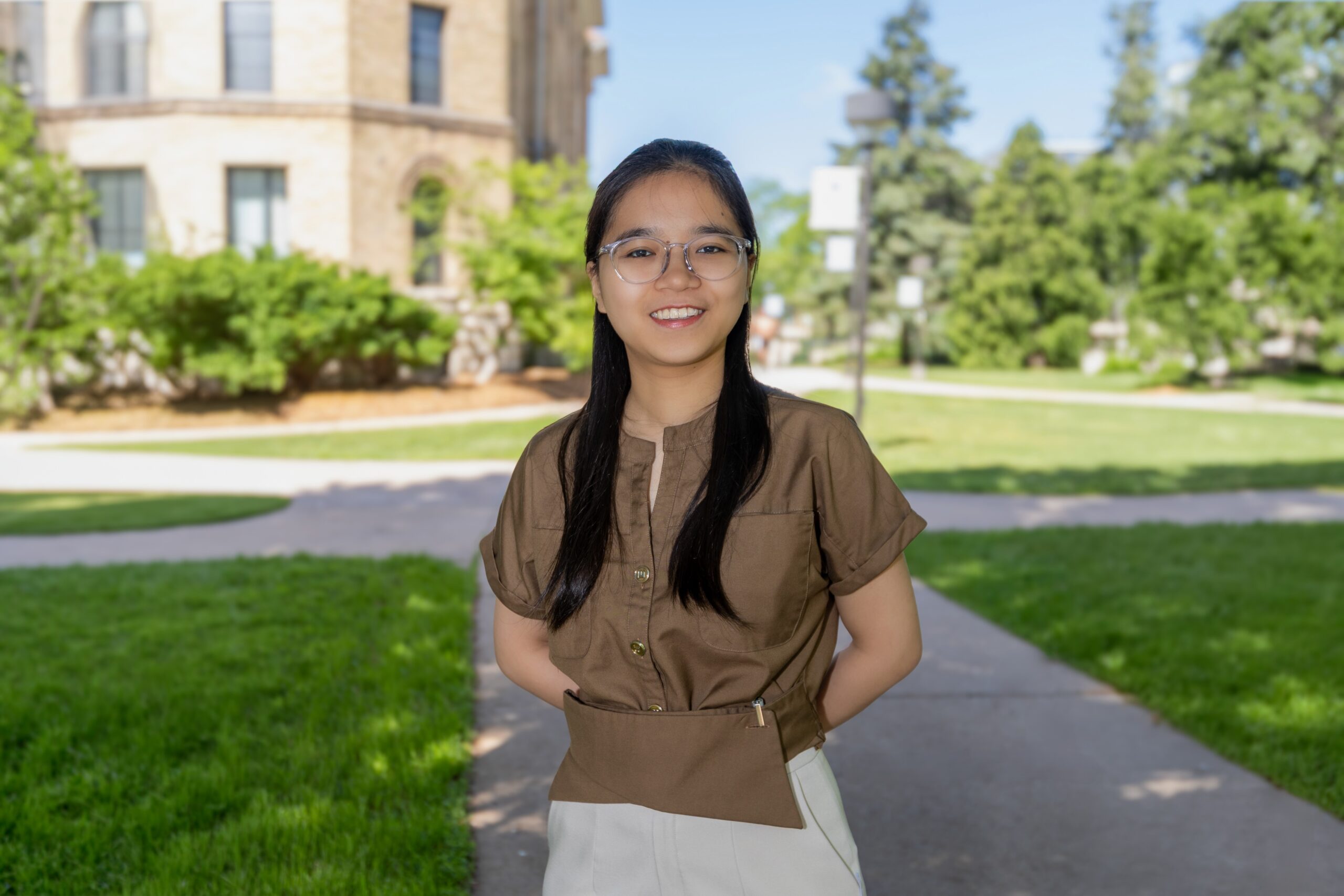
Lawrence University graduate Cao Le Quynh Anh ’26 will begin a fully funded master’s degree as a Yenching Fellow at Peking University in Beijing this fall, joining one of the world’s most prestigious programs for emerging global leaders, with an annual acceptance rate typically under 3%.
The master’s program brings together outstanding young leaders from around the world to study China through an interdisciplinary lens. It combines academic study, research, cultural immersion, and leadership development, helping fellows deepen their understanding of China’s history, society, politics, and global role while building an international network of future changemakers.
“I have always longed to become a serious scholar of China,” Quynh Anh said. “It is not just about my personal interest in and fascination with Chinese civilization, but also because, for every Vietnamese person, understanding China thoroughly is a critical task.”
A native of Hanoi, Quynh Anh said she was thrilled when she learned she had been selected for the fellowship after a months-long application process.
“Yenching was my first choice, so waiting for the result was so hard to bear,” she said. “The moment I got the results, I was super happy and felt like all my hard work had paid off.”
Quynh Anh views the Yenching Fellowship as an important step toward earning a PhD in China Studies and eventually pursuing a career in academia and public policy. She said the program’s emphasis on immersion, field research, scholarly collaboration, and language development will provide opportunities to deepen her understanding of China beyond what can be learned through academic literature alone.
She was selected as one of only two Vietnamese students in this year’s cohort, an achievement she said affirmed both her aspirations and the vision she presented during the competitive selection process.
What excites her most about the opportunity is the chance to engage directly with people and communities throughout China while gaining a deeper understanding of the country’s internal dynamics.
“I am most excited about exchanges with people from all walks of life and field experiences that will help me learn more about the on-the-ground tacit knowledge in China,” she said.
The decision to attend Peking University was not made lightly. Quynh Anh chose the Yenching Fellowship over a full scholarship offer to study China Studies at Oxford University, believing Yenching would provide unparalleled opportunities for firsthand experience with Chinese society.
“Two years at Yenching will be a very strategic experience for me to truly grasp China’s stories,” she said. “The on-the-ground knowledge we will be able to gain at Yenching is unparalleled.”
At Lawrence, Quynh Anh was a Dean’s List student, an active member of the campus community, and a recipient of the Mita Sen Award for Societal Impact, which recognizes students whose work demonstrates the potential to create positive change in society. She graduated summa cum laude with a Bachelor of Arts in International Relations and Asian Studies.
She credits Lawrence’s liberal arts environment with preparing her for the interdisciplinary nature of the Yenching program.
“The interdisciplinary nature of a liberal arts education like Lawrence’s gave me perfect preparation for a fellowship like Yenching,” she said.
Yenching studies China through six tracks: Law & Society, Politics & International Relations, Arts & Literature, Economics & Management, History & Archaeology, and Philosophy & Religion. Quynh Anh said Lawrence faculty helped her examine China through a similarly broad lens.
“Thanks to Ma Laoshi and Professor Vance, our two wonderful China specialists on campus, I was trained to reflect on China from diverse perspectives that go beyond my political science background,” she said.
At Lawrence, Quynh Anh learned a great deal about Chinese philosophy in pre-imperial China and connected it with the current revival of Confucianism under Xi Jinping’s era.
“Under Professor Vance, I linked the crisis of China’s New Youth with social tension and criticism of humanism in Jia Zhangke’s films,” Quyna Anh shared. “I also truly observed a rising China on African soil through a field trip to The Gambia with professor Skran, where I saw how the dominant Chinese fishing industry is overtaking African ports.”
After completing the Yenching program, Quynh Anh hopes to pursue a PhD focused on Sino-Vietnamese comparative politics. Long-term, she hopes to become a professor and contribute to conversations about Vietnam’s political development and future.
“I want to become a political thinker for my nation,” she said. “I want to leave a legacy of thought on a nationwide scale.”
As she prepares to leave for Beijing, Quynh Anh said she remains grateful for the role Lawrence played in shaping her journey.
“These four years were life-changing for me,” she said. “They truly transformed me. Thanks to all the Lawrence professors. I believe that wherever my next destination is, no place can beat the supportive environment that I once enjoyed at Lawrence.”
Quynh Anh said she just had a call with another Lawrentian who is currently a PhD student at Vanderbilt and who was also a Yenching Scholar seven cohorts before her.
“She said the same,” Quynh Anh said. “There is a Chinese saying that expresses this gratitude that I would love to share with my professors: 一日为师, 终身为父 (“A teacher for a day, a father for a lifetime.”)