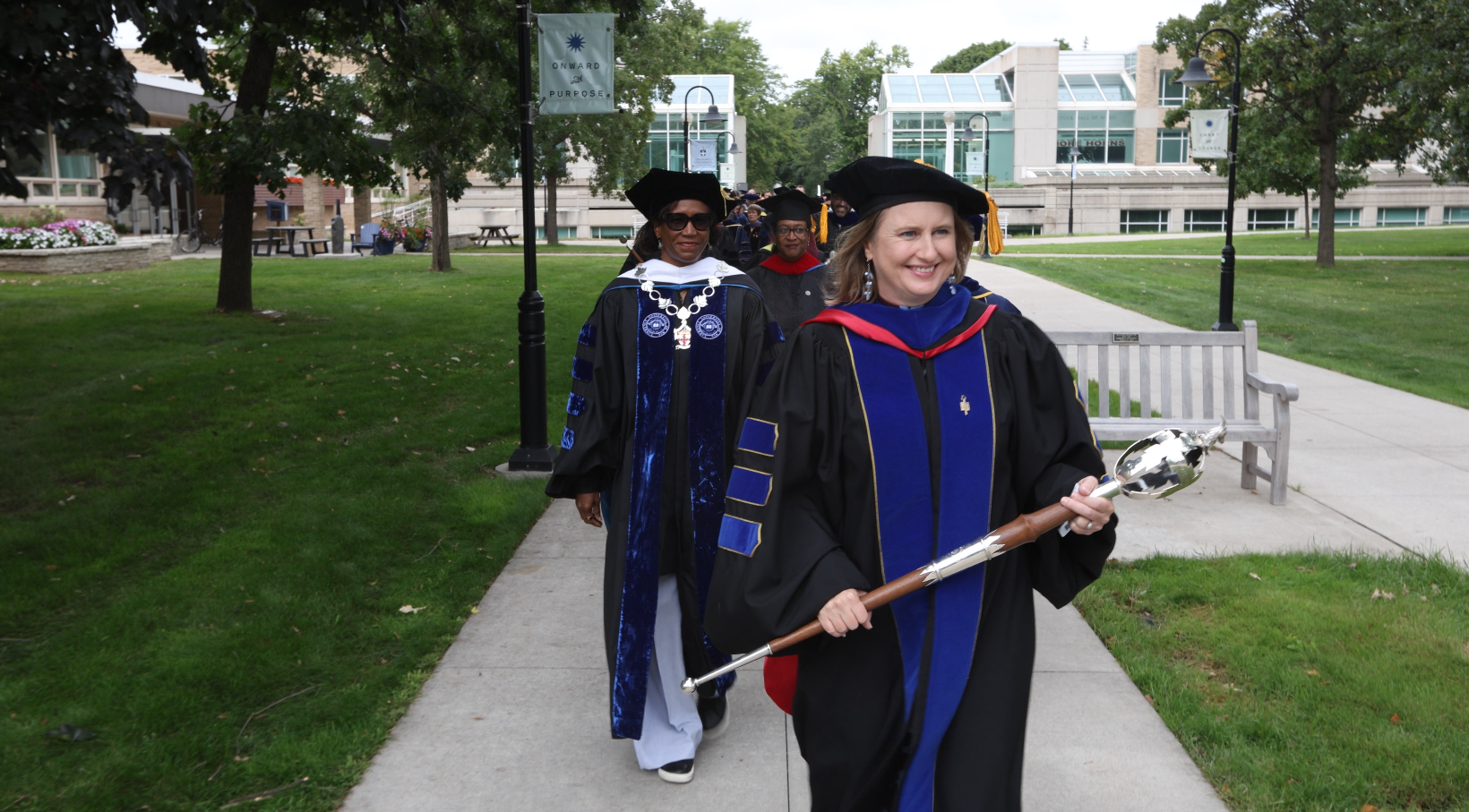
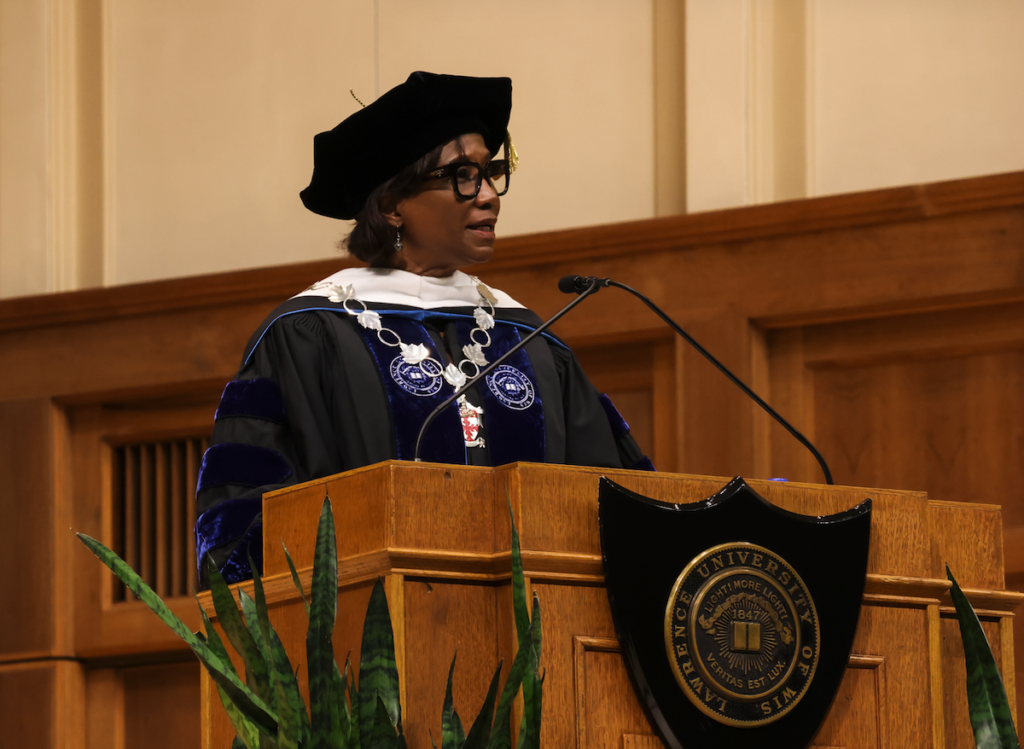
Lawrence University President Laurie A. Carter challenged students, faculty, staff, and Fox Cities community members to embrace community as both a responsibility and a shared purpose as she welcomed the campus community to the 2026-27 academic year during Matriculation Convocation.
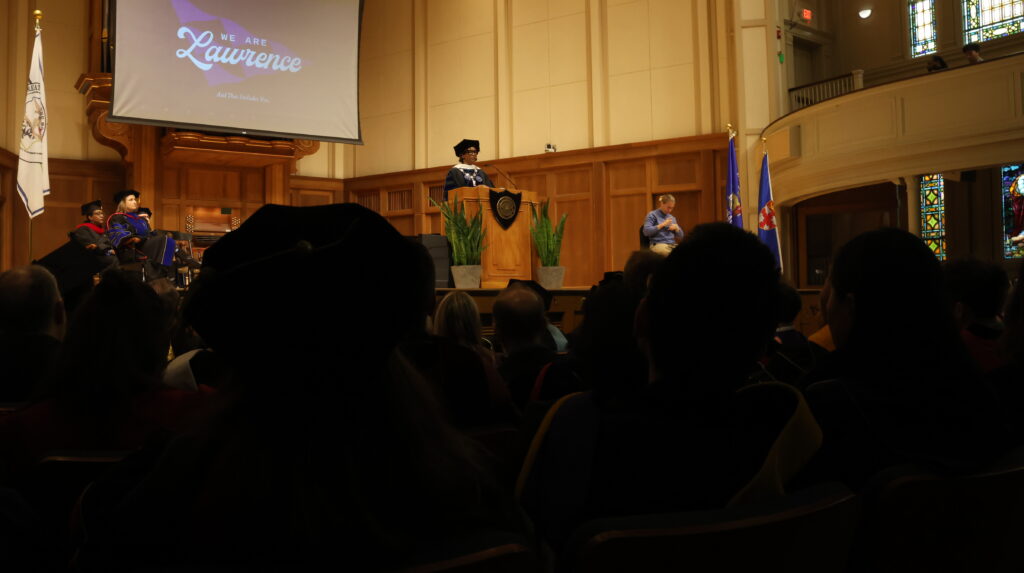
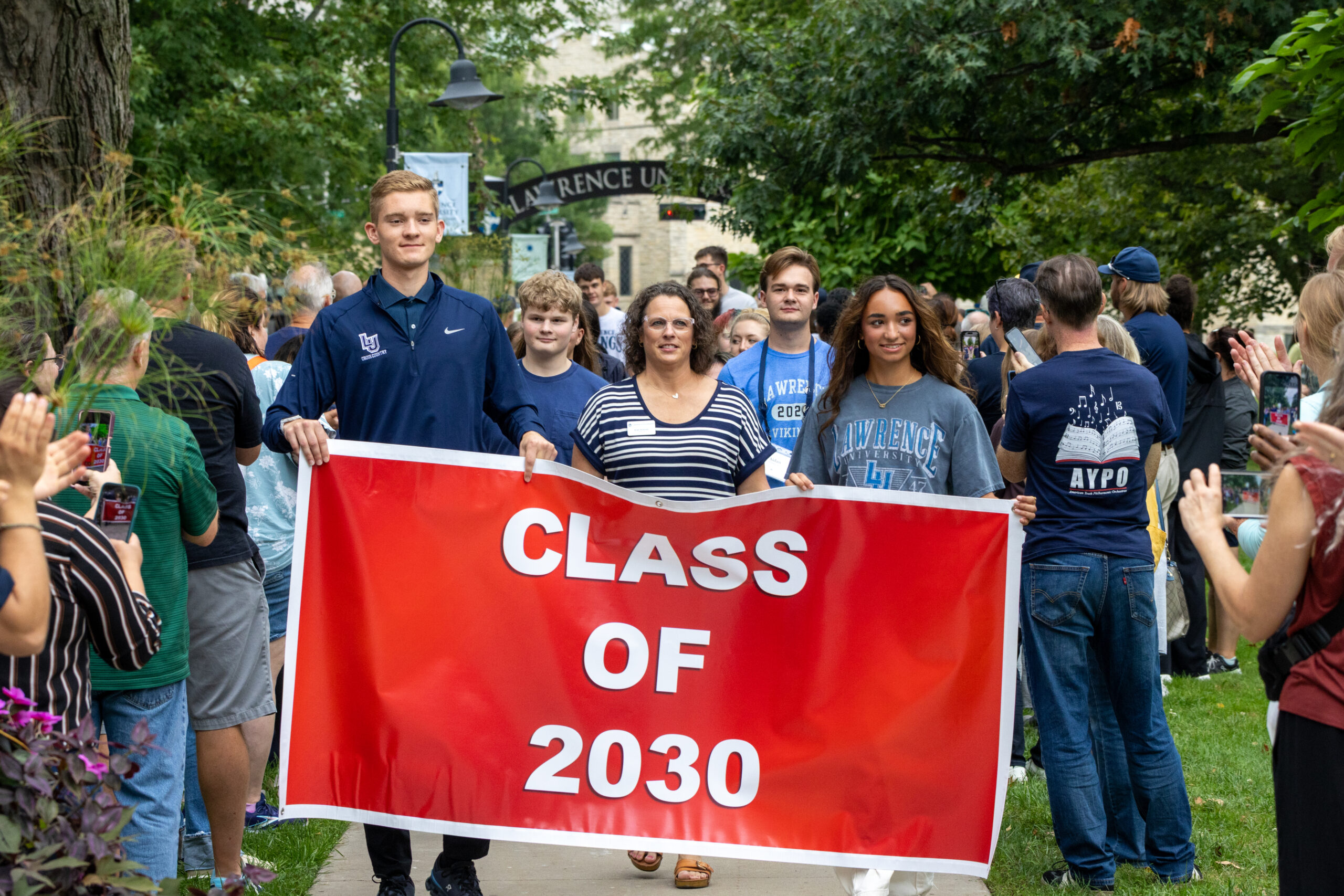
This year, Lawrence welcomed 391 incoming students, 346 first-year, 29 transfer, and 16 international students to campus. The new students are from more than 37 states and 10 countries.
Carter framed the annual ceremony as an opportunity to reflect on a fundamental question: “Who are we, together?”
Throughout the address, she returned repeatedly to the idea that community is not defined by geography or circumstances, but by the choices people make to support, learn from, and care for one another.
“Community is neither simple nor automatic,” Carter said. “Community is something deeper: it is a commitment. It is a relationship. It is a responsibility.”
Drawing on the work of philosopher and educator John Dewey, Carter said community is created through interaction and communication. She pointed to both moments of loss and moments of celebration over the past year as examples of how the Lawrence community has demonstrated its strength.
She referenced the deaths of Professors Garth Bond and Danielle Joyner and alumnus Alex Stanger ’25, noting that community is revealed not only in grief but in the ways people honor and extend the impact of those who have been lost.
“Community transforms loss into purpose, remembrance into action, and individual lives into lasting legacies that continue to shape those who follow,” Carter said.
As one example, she highlighted the recent creation of the Art History Travel Fund by Dale Schuh ’70 and his wife, Annette, in honor of Joyner. The fund will support student learning opportunities while preserving Joyner’s legacy.
Carter also pointed to milestones that reflect Lawrence’s future, including the naming of Hall Commons in honor of Susan Long Hall ’76 and her family, and plans for The Hub, the university’s new wellness, recreation, and creative arts facility in downtown Appleton.
“Communities are built only through shared purpose, mutual care, and collective effort,” she said.
Lessons from Beyond Campus
Carter shared a personal story about helping organize a family reunion in her hometown, an experience that reinforced for her the evolving nature of community.
The reunion was originally scheduled to begin at an American Legion Post established in 1947 by Calvin J. Spann, one of the original Tuskegee Airmen. The post was created at a time when many Black veterans lacked welcoming places to gather and find support.
Weeks before the event, however, an SUV crashed into the building, causing significant damage and forcing her family to find another location.
A neighboring American Legion Post immediately agreed to host the gathering.
For Carter and her family, the gesture carried special significance because the welcoming post represented a place that decades earlier would not have accepted African American veterans.
“We were reminded that communities are not fixed. They evolve,” Carter said. “Walls that once divided people can come down.”
She added that a strong community grows when more people can see themselves within it.
“A community is strongest when more people can say, ‘This place belongs to me, too,’” Carter said.
Community Revealed in Times of Challenge
A second lesson in community emerged closer to home when a tornado struck the Fox Cities region this summer.
While Lawrence’s campus avoided the most severe damage, neighboring communities, including Menasha and Doty Island, experienced significant destruction.
Carter praised the response that followed, including volunteers who assisted community members, those who helped displaced colleagues, and efforts to support Menasha High School after the storm.
“Across the Fox Cities, neighbors helped neighbors,” she said. “Strangers became partners. Communities became stronger by refusing to leave anyone behind.”
She also thanked Joe King, associate vice president for facilities, and his team for their work restoring the Lawrence campus following the storm.
Among the losses was a beloved tree on Main Hall Green that suffered irreparable damage. Carter said the university has worked to preserve portions of the tree for future educational and campus uses, including potential teaching and research projects.
Its legacy, she said, serves as a reminder that community is connected not only to people, but also to the places and traditions that help define an institution.
“Community is not measured during moments of comfort,” Carter said. “Community reveals itself during moments of challenge.”
The Liberal Arts and Responsibility to Others
Carter connected the theme of community to Lawrence’s educational mission, describing the liberal arts as more than a collection of academic disciplines.
“The liberal arts are not simply a collection of disciplines,” she said. “They are a way of understanding human relationships and human possibility.”
While higher education is often discussed in terms of careers and professional outcomes, Carter encouraged students to consider a broader question.
“What obligations do I have to others?” she asked.
That question, she said, lies at the heart of both a liberal arts education and civic engagement.
The liberal arts prepare students not only for employment but also for citizenship, leadership, and participation in communities. Universities, she said, play an important role in helping people build connections across differences and learn to engage productively with perspectives unlike their own.
“A healthy community does not eliminate differences,” Carter said. “It creates the conditions for differences to coexist productively.”
Celebrating Achievement
Carter also highlighted accomplishments from across the Lawrence community, including faculty, staff, students, and alumni.
Among those recognized were Erin Lesser, who was named the Kimberly-Clark Professor of Music; Graham Sazama, who received a National Science Foundation Research in Undergraduate Institutions grant; and Emma Snyder, managing director of the Business & Entrepreneurship Center, who was honored as a Future 15 recipient by the Fox Cities Chamber of Commerce.
She also pointed to the accomplishments of students and recent alumni, including Yenching Fellow Cao Le Quynh Anh ’26, Fulbright recipients Kaitlin Buelow ’26 and Jude Lawler ’26, and bluegrass musicians Tashi Litch ’24, Evan Snoey ’23, and Ben Lewis ’25, who took first place in the Telluride Bluegrass Band Contest.
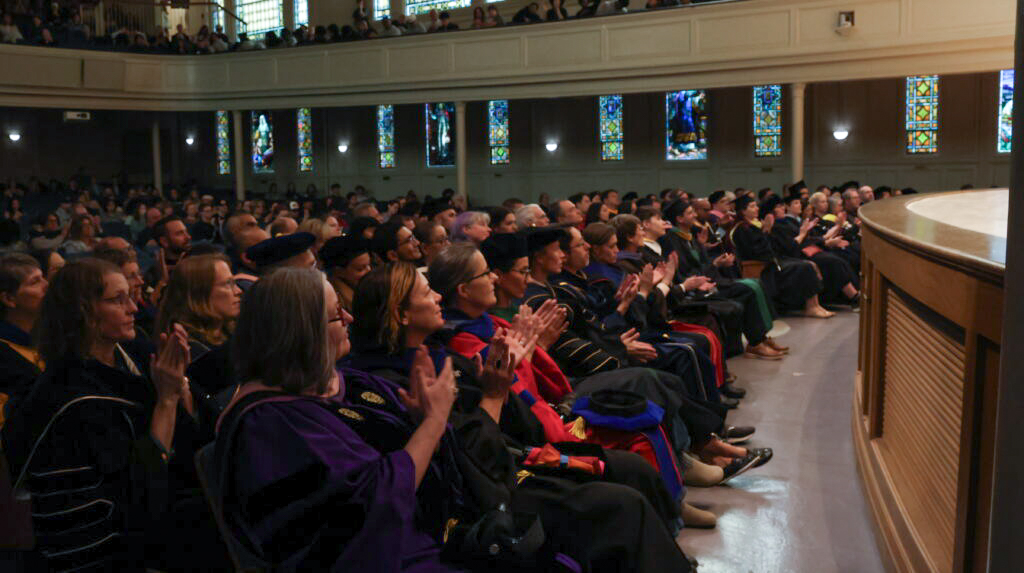
While the achievements reflected individual excellence, Carter emphasized that none occurred in isolation.
She said those accomplishments reflected the support of faculty, staff, mentors, classmates, family members, and friends who helped make them possible.
“Achievement may be recognized individually,” she said. “But it is almost always nurtured collectively.”
Looking ahead
As Lawrence approaches its 180th anniversary in 2027, Carter called on students, faculty, and staff to view themselves as stewards of an institution built and sustained across generations.
She pointed to several initiatives that will help shape Lawrence’s future, including the opening of The Hub, the completion of the Memorial Chapel façade restoration, implementation of the new Liberal Arts Requirements, and the launch of Lawrence Compass, a student-success ecosystem that will unify advising, academic support, and career development resources.
The Hub and Memorial Chapel, Carter said, represent complementary aspects of the university’s future.
“Memorial Chapel reminds us that community requires continuity,” she said. “The Hub reminds us that community requires innovation.”
Looking to the year ahead, Carter encouraged students to seek experiences and relationships beyond their comfort zones.
“Follow your curiosity into spaces and experiences that feel unfamiliar,” she said. “Take a class that challenges your assumptions. Strike up a conversation with someone whose experiences differ from your own.”
She closed the address by reminding the Lawrence community that belonging is not something that simply exists. It is something that must be built and renewed through everyday actions.
“Community is not something we inherit fully formed,” Carter said. “It is something we create together.”
Quoting theologian Howard Thurman, Carter urged the audience to remain open to new people and perspectives, saying communities flourish when they welcome others into their midst.