
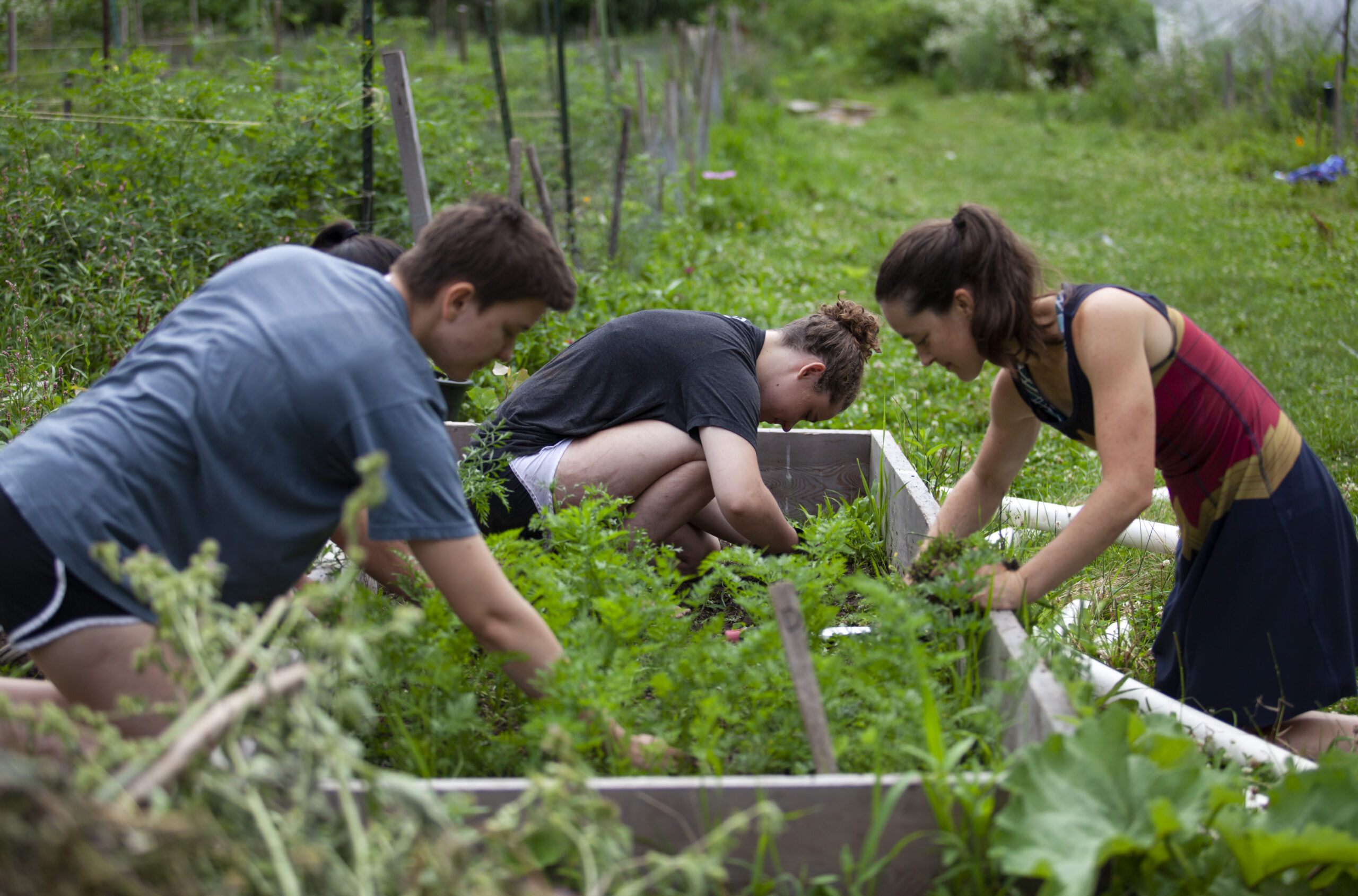
Program Overview
The Environmental Science major draws from the curricula of multiple departments to equip students with the tools to investigate complexly interconnected Earth systems. Environmental Science majors develop a sense for the intrinsic time scales of environmental processes, for the evolution of environmental systems in the past, and for how these systems are likely to change in the future, especially as a result of human activities. Environmental Science students also learn to communicate technical concepts effectively both to other scientists and to public audiences. The major includes a rigorous core of required courses but also leaves significant latitude for each student to shape an individualized academic plan. Environmental Science majors will be well prepared for graduate study or work in the corporate, government, or non-profit sectors.
Program Highlights
Study the Environment Across Sciences
Combine approaches from biology, chemistry, and the geosciences to better understand complex environmental systems.
Learn Through Field Experience
Take your studies beyond the classroom through fieldwork in locations ranging from Lake Superior to the Caribbean.
Create Your Own Capstone
Reflect on your growth, shape your academic path, and complete an independent capstone project, often in collaboration with a faculty mentor.
Spotlight

LAWRENTIAN SPOTLIGHT
Student Perspective
“[My Lawrence summer research project*] … uncovers an effective path toward climate change adaptation and resiliency for the world’s most vulnerable groups.”
Gaston Kaisin ’22,
Environmental Studies, Music (Trumpet)
Guilford, Connecticut
* Findings from this research were included in a climate change assessment report by the Intergovernmental Panel on Climate Change.

Types of Degrees
Students can pursue a Bachelor of Arts in Environmental Science, with options to focus on topics such as climate change, sustainable agriculture, water resources, environmental geochemistry, and terrestrial and aquatic ecosystems.
Advising
At Lawrence, academic advising helps you shape an educational experience that reflects your interests, goals, and aspirations. Your faculty advisor will support you as you plan your path, connect with campus resources and communities, and make informed decisions that prepare you for a meaningful and fulfilling future.

Faculty
Engage deeply and collaboratively with professors who are experts in their field and committed to supporting your education.
Chair(s)

Andrew Knudsen
Professor of Geosciences
Interests: environmental mineralogy, low-temperature geochemistry
View Full ProfileAll Faculty
-

Deanna L. Donohoue (she/her)
Associate Professor of Chemistry
deanna.l.donohoue@lawrence.edu
Her research has included work on the gas phase oxidation of mercury in the atmosphere, halogen chemistry of the arctic and the use of remote sensing, and the impacts of…
View Full Profile -

Marcia Bjornerud
Walter Schober Professor of Environmental Studies and Professor of Geosciences
Marcia Bjornerud is a structural geologist whose research focuses on the physics of earthquakes and mountain building. She combines field-based studies of bedrock geology with quantitative models of rock mechanics.…
View Full Profile -

Jason Brozek
Stephen Edward Scarff Professor of International Affairs and Associate Professor of Government
Jason Brozek is Associate Professor of Government and Stephen Edward Scarff Professor of International Affairs, and since joining the faculty in 2008, has taught courses on global politics, international law,…
View Full Profile -

Jeffrey J. Clark (he, his)
Professor and Chair of Geosciences
My research explores human interactions with the physical environment, both how humans shape Earth’s surface, and how natural processes have shaped human habitation. I’ve looked at sediment storage changes in…
View Full Profile -

Alyssa S. Hakes (she/her)
Associate Professor of Biology
I am an ecologist who studies plant-insect interactions. I am interested in the factors that influence the amount of damage plants receive from insects. My lab has explored plant-herbivore interactions…
View Full Profile -
Andrew Knudsen
Professor of Geosciences
Interests: environmental mineralogy, low-temperature geochemistry
View Full Profile -

Relena R. Ribbons (she/her/hers)
Associate Professor of Geosciences
Dr. Ribbons is a forest and soil ecologist, and biogeochemist in the Geosciences Department and Environmental Studies program. Her interests range span soil microbial ecology, geobiotic interactions, and ecosystem ecology. She…
View Full Profile -

Jodi Sedlock (she/her)
Dennis and Charlot Nelson Singleton Professor of Biological Sciences
I have been exploring the secret lives of bats for many years, mostly across the diverse archipelago of the Philippines in Southeast Asia. In collaboration with Filipino scientists and conservation…
View Full Profile
Learning Spaces
As an environmental science major, you’ll study how human activity affects the environment, and how environmental problems affect humans. The scientific process will become second nature as you use it to explore questions about the natural world. You’ll learn from experts across a range of natural science disciplines, especially geosciences, biology, and chemistry. You will be trained in the classroom and lab combined with opportunities to study a variety of environmental systems in the field. By the time you graduate, you’ll have firsthand experience devising scientific solutions to the environmental challenges our world faces today and tomorrow.
