

Program Overview
Anthropology students at Lawrence study human culture, society and biology, past and present. Students gain practical experience with field- and lab-based methods in archaeology, ethnography, and human biology. Our ideas- and problem-based curriculum encourages students to apply anthropology to understanding health, migration, sustainability, and other urgent contemporary issues, preparing them for careers in government, non-profits, healthcare, business, consulting, data science, education and more. We encourage field school training and study abroad. Anthropology students at Lawrence learn new perspectives on what it means to be human and develop needed skills for human-focused careers.
Program Highlights
Bring Your Learning to Life
Access funding for summer research, field schools, and community-based experiences that connect your interests with meaningful, hands-on learning.
See Challenges from Every Angle
Combine quantitative and qualitative methods with humanistic and scientific perspectives to explore complex questions with greater depth.
Prepare for a Future in Health
Build a human-centered understanding of health and well-being that can help you stand out when applying to medical school or graduate programs in health sciences and public health.
Types of Degrees
Students can pursue a Bachelor of Arts in Anthropology with options to focus their studies in archaeology, biological anthropology, or cultural anthropology with links to Asian studies, data science, environmental studies, ethnic studies, gender studies, health and society, and more. A minor in Anthropology is also available.
Advising
At Lawrence, academic advising helps you shape an educational experience that reflects your interests, goals, and aspirations. Your faculty advisor will support you as you plan your path, connect with campus resources and communities, and make informed decisions that prepare you for a meaningful and fulfilling future.

Faculty
Engage deeply and collaboratively with professors who are experts in their field and committed to supporting your education.
Chair(s)

Mark Jenike (he/him/his)
Professor of Anthropology
I am a human biologist specializing in nutrition. I teach courses on health, human evolutionary biology, and nutritional anthropology. I enjoy community-based research in the Fox Valley region and have…
View Full ProfileAll Faculty

Carla Daughtry (She/Her/Hers)
Associate Professor of Anthropology
As a cultural anthropologist, I teach and research Middle East and North African societies; migration, immigration and globalization; race, ethnicity and gender across cultures; anthropology of food and food justice…
View Full Profile
Brenda Jenike (she/her/hers)
Edward F. Mielke Professor of Medicine, Health and Society and Associate Professor of Anthropology
I’m a cultural and medical anthropologist whose courses include ethnography of Japan and East Asia, medical anthropology, disability studies, culture and aging (cultural gerontology), the anthropology of biomedicine, and the…
View Full Profile Mark Jenike (he/him/his)
Professor of Anthropology
I am a human biologist specializing in nutrition. I teach courses on health, human evolutionary biology, and nutritional anthropology. I enjoy community-based research in the Fox Valley region and have…
View Full Profile
Peter Neal Peregrine
Professor Emeritus of Anthropology
peter.n.peregrine@lawrence.edu
View Full Profile
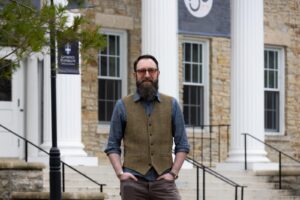
Kurt Wilson (he/him/his)
Assistant Professor of Anthropology
I am an anthropological archaeologist who is interested understanding human-environment interactions with a particular focus on how human behaviors and local ecologies influence inequality, dietary change, territoriality, cooperation, and related…
View Full ProfileLearning Spaces
Anthropology students can choose to learn through hands-on work in dedicated lab and field settings. Often driven by their own questions, they can learn participant observation, interviewing, surveying, nutritional assessment, remote sensing, high-precision site mapping, advanced computing tools, and more. Whether through exploring our archaeological and ethnographic artifact collections or working at archaeological or community-based field sites, students collect, document, and interpret data in active research environments with professional equipment and analytical tools, guided by both internal and external faculty. Students are encouraged to join faculty research projects or generate independent projects through established partnerships with local educational and health organizations, the Anthropology Collections, the LU Archaeology Lab, and more.
